
Enchroma Lenses for Colorblindness

Color blindness is more common than you’d expect, and for the first time, a color blind individual can experience the vibrancy of color thanks to EnChroma glasses. EnChroma’s patented lens technology makes colors visible so you can see the vibrancy of reds and oranges, blues and purples or more vibrant greens.
According to genetic population statistics, it is estimated that 4 out of 5 cases of color are forms of partial color blindness (also called anomalous trichromacy) which are addressable using the EnChroma optical lens technology.
Color Blindness - Color Vision Deficiency
Color blindness (also called color vision deficiency by vision scientists), is a condition in which the retinal cone cells respond to light differently than normal. People with color blindness can usually still see colors but have color confusions or see certain pairs of colors so similarly that they cannot tell them apart.
Color blindness is a common vision problem, especially in men. Approximately 1 in 12 men and 1 in 200 women have some degree of color blindness. There are different types of color blindness but the most common is known as ‘red-green color blindness.’
It is often an inherited condition, but may also result from injury to the eye, disease, side effects from medication and aging.
Check out some designer frames we carry at our Professional Eyecare Solutions optical.
TYPES OF [COLOR] BLINDNESS

Deutan Color Blindness
Deutan color blindness (also known as deuteranomaly) is a type of red-green color blindness in which the green cones in the eye detect too much red light and not enough green light.
As a result red, yellow, green, and brown can appear similar, especially in low light. It may also be difficult to tell the difference between blues and purples, or pinks and grays. Learn more about Deutan and other types of color blindness.
Protan Color Blindness
Protans are people with protanomaly, a type of red-green color blindness in which the red cones do not detect enough red and are too sensitive to greens, yellows, and oranges.
As a result, greens, yellows, oranges, reds, and browns may appear similar, especially in low light. It can also be difficult to tell the difference between blues and purples, or pinks and grays. Red and black might be hard to tell apart, especially when red text is against a black background. Learn more about Protan and other types of [color] blindness.


Tritan Color Blindness
Tritan-type color vision is characterized by a loss of color discrimination for shades of blue and yellow, but it isn’t a form of color blindness.
This condition can be caused by age-related factors, genetics, as well as exposure to certain toxins like mercury. A complete diagnosis of color vision deficiency isn’t possible using online testing. Consult an eye care professional for more information.
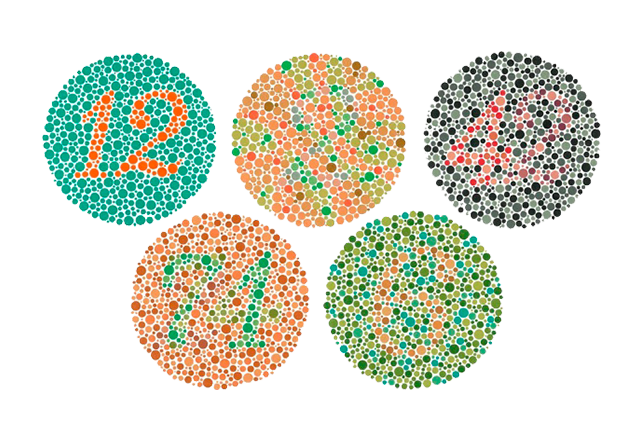
Are You [Color] Blind?
Try the EnChroma Color Vision Test
What Causes Color Blindness?
The human eye contains three color-sensitive photopigments in the retina, inside receptors called cones. These cones interpret levels of blue, red, or green in a given object. That information is then sent to your brain, where it’s perceived as sight.
Most cases of color blindness occur as a result of an abnormal response to light wavelengths. This affects cone cells that normally are sensitive to either red or green wavelengths of light. The abnormal sensitivity to these wavelengths results in color blindness.
How Do EnChroma Glasses Work?
To compensate for the abnormal cone response that results in color blindness, EnChroma glasses filter the wavelengths of light that cause this overlap to occur. And voila! The brain is now better able to tell the difference between red wavelengths and green wavelengths, allowing you to see colors more distinctly.
Though EnChroma glasses can’t cure your color blindness or produce 100% normal color vision, they will allow you to see colors you’ve never been able to see before and experience almost-normal color vision.
Are You Color Blind? Consider EnChroma Glasses!
EnChroma glasses can help with severe color blindness, but work best for those with mild or moderate color blindness. Those who wear them can now see their spouse’s piercing green eyes and appreciate the vibrant colors in their garden. Or experience the beauty of a sunset for the first time.
Up to 80% of people with color vision problems benefit from EnChroma lens technology.
Want to know more about EnChroma glasses and see if this revolutionary eyewear technology is right for you? Come visit our eye doctors at Professional Eyecare Solutions in Palm Beach Gardens today!